
What Is a Sewer Camera Inspection?
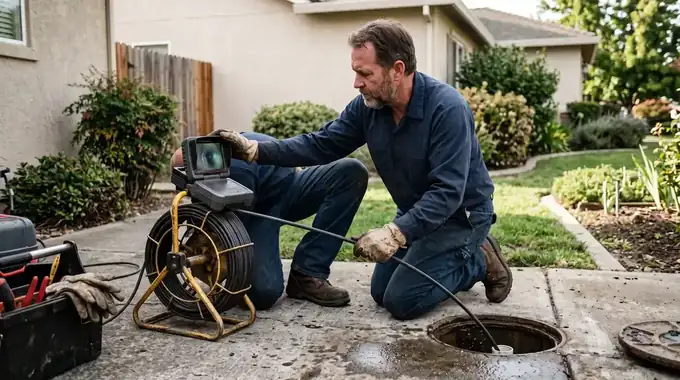
A sewer camera inspection — also called a sewer scope or drain scope — is a diagnostic procedure, not a repair. A technician feeds a flexible cable with a waterproof camera head into your drain system through a cleanout port or a drain opening. The camera transmits a live video feed to a monitor, and the technician records the footage while navigating the cable through your drain lateral to the point where it connects to the municipal sewer system.
The result is a visual record of what the inside of your pipes looks like at that moment in time: the pipe material, its condition, any buildup or blockages, root growth, pipe deformation, or evidence of damage. This is direct, objective evidence — what you see on the screen is what's in your pipes.
Unlike many diagnostic procedures, a sewer camera inspection doesn't require excavation, chemical treatment, or any disruption to the structure of your home. The camera enters through an existing access point, and the inspection itself leaves the pipes exactly as it found them (unless a cleaning or clearing step is added). For a Medford homeowner trying to understand a recurring drain problem or evaluate the condition of older pipes, it provides information that no other simple test can.
| Sewer Lateral Material | Common Medford Neighborhoods | What the HD Camera Reveals | How 512 Hz Locating Helps |
|---|---|---|---|
| Vitrified Clay Tile | McLoughlin, Downtown, Liberty Park, Old West Medford (Pre-1955) | Tree root masses entering mortar joints every 2–3 feet; cracked or offset clay bells | Marks the exact lawn spot and depth of collapsed joints so healthy sections are not dug up |
| Orangeburg (Bituminized Fiber) | 1950–1972 pockets in West, South & North Medford | Blistered, delaminating walls and oval pipe deformation under driveway/soil load | Maps exact lateral route and depth from house to street main for clean replacement |
| Cast Iron Building Drains | 1920s–1975 under slabs, basements & crawlspaces | Heavy rust scale catching paper or rotted-out bottom channel (channel rot) | Pinpoints sub-slab or crawlspace transition wyes accurately |
| ABS / PVC Plastic | 1975–Present (East, North, SE & SW Medford) | Standing-water bellies from expansive clay settling, or sheared foundation joints | Measures exact footage and depth of the sagged section |
Situations That Call for a Sewer Camera Inspection
Not every drain problem calls for a camera inspection, but a number of common situations make one the logical next step. The following are the most consistent indicators.
Before Buying a Home
A standard home inspection evaluates what is visible — the inspector cannot see what is inside your sewer lateral or assess its condition from outside. Homes in Medford that were built before PVC sewer pipe became standard may have clay tile or cast-iron drain lines that are decades old. A sewer scope performed as part of a pre-purchase due diligence process lets you know whether the drain system is in good condition, whether roots have already entered the line, or whether a significant repair is likely in the near term. This information has real value in a real estate negotiation.
Repeated Drain Clogs or Slow Drains
A drain that clogs once and clears easily is often just a buildup issue. A drain that clogs repeatedly — or that never quite drains as freely as it should even after snaking — is communicating something. The snake may be clearing a partial obstruction without reaching the underlying cause. Camera inspection identifies whether the recurrence is structural: a root mass that regrows after each clearing, a partially collapsed pipe that restricts flow, or a scale and grease accumulation that snaking repeatedly moves rather than removes.
Sewage Smells Inside or Outside the Home
Sewer gas — primarily hydrogen sulfide — is produced by decomposing waste in the drain system. Under normal conditions, the water in your trap fixtures seals the drain and prevents gas from entering your home. If you're consistently detecting sewage odor inside — particularly in bathrooms, laundry rooms, or basement drains — without an obvious fixture-level cause, the drain line itself may have a crack, a broken joint, or a compromised seal that is allowing gas to escape. Camera inspection can identify cracked pipe walls and open joints that allow gas migration.
Multiple Drains Backing Up at Once
When a single fixture backs up, the blockage is typically local — in the branch line serving that fixture. When multiple drains in different parts of the home back up at the same time, the blockage is most likely in the main sewer lateral downstream of where those branch lines converge. This is a strong indicator that camera inspection is the right call. Snaking a branch line when the main lateral is the problem produces only temporary relief, and in the meantime the risk of a sewage backup inside the home increases.
Tree Roots on Property Near Drain Lines
If you have mature trees — particularly species with aggressive root systems, such as willow, poplar, or large ornamental trees — growing within twenty to thirty feet of your sewer lateral's path, root intrusion is a realistic risk even before you have symptoms. Root systems seek moisture and can enter pipe joints and cracks long before the intrusion is significant enough to affect flow. A periodic camera inspection provides an objective baseline and catches root growth while it is still manageable.
Unexplained Wet Patches in the Yard
Wet areas in the yard can indicate either a water supply line leak or a broken sewer lateral. The distinction matters because the remediation is different. If your water meter test (described in the underground leak article) shows no supply line loss but you still have a persistently wet yard, your sewer lateral is a reasonable suspect. Camera inspection can confirm whether the pipe has a crack or separated joint that is allowing sewage effluent to escape into the surrounding soil.
An Older Home With Clay Tile or Cast-Iron Drain Lines
Homes built in Medford before the 1970s — and many built into the 1980s — commonly used vitrified clay tile or cast-iron pipe for their sewer laterals. Both materials can provide long service lives, but both are also susceptible to deterioration over decades. Clay tile joints use bell-and-spigot connections that can separate with soil movement. Cast-iron pipe corrodes from the inside as a result of hydrogen sulfide exposure over time. If you own or are purchasing an older Medford home and the drain system has not been inspected recently, a camera scope gives you a factual picture of what you have.
What a Sewer Camera Can Reveal
The camera provides a direct visual record of the pipe interior. Here are the most common findings in residential sewer inspections:
- Root intrusion: Fine root tendrils or larger root masses entering through joints or cracks. Roots appear fibrous and white or pale in the camera image. Early-stage root presence is easier to address than an established root mat.
- Pipe offset or separated joints: Sections where the pipe has shifted out of alignment — visible as a ledge or lip inside the pipe where one section no longer meets the next smoothly. Offsets restrict flow, catch debris, and allow root entry.
- Pipe collapse or belly: A "belly" is a low point in the pipe created by soil settlement beneath the line. Water and waste pool in the belly rather than flowing freely. Camera footage shows the pooled liquid at the low point. A full collapse is a section where the pipe has buckled inward.
- Scale and grease buildup: Years of accumulation on pipe walls reduces the effective diameter. Camera footage shows the buildup clearly as a dark, irregular coating on the interior surface.
- Cracked or corroded pipe walls: Visible as fracture lines or areas of irregular surface texture. In cast-iron pipe, interior corrosion appears as rough, pitted metal or flaking material.
- Foreign object blockages: Wipes, feminine hygiene products, children's toys, and other items that should not be in a drain are occasionally found during camera inspection — often near the source of a persistent clog.
What a Sewer Camera Inspection Cannot Do
A sewer camera is a powerful diagnostic tool, but it has real limitations that homeowners should understand before relying on it as a complete answer.
It only shows the inside of the pipe. The camera cannot tell you what the pipe looks like from the outside, whether surrounding soil has shifted significantly, or whether external pressure is being applied to the pipe from above. A pipe that looks intact on the inside may have external cracking or joint separation that isn't yet visible on the interior surface.
It cannot locate where the pipe is. The camera shows what's in the pipe but does not produce a precise GPS location of a specific problem area. Some inspection systems include a transmitter on the camera head that can be traced from the surface to identify exact depth and location — this is a useful addition when excavation planning is needed.
It is not a substitute for water supply leak detection. Sewer camera inspection is a drain diagnostic tool. It does not test water supply pipes, pressurized lines, or anything upstream of where waste enters the drain system. If your problem is a supply line leak, a water line pressure test and acoustic detection are the appropriate tools — not a camera scope.
It cannot measure water tightness. The camera shows visible cracks, but a very fine hairline crack that is leaking sewage into the soil may not be definitively visible on camera. Smoke testing or hydrostatic testing of the drain lateral provides a functional water-tightness assessment that complements camera inspection.
Clay Tile and Cast-Iron Sewer Lines in Older Medford Homes
Medford's housing stock includes a significant number of homes built in the mid-twentieth century, during which clay tile and cast-iron pipe were the standard materials for residential sewer laterals. Both materials were durable in their time and many are still in service today — but both are also now at ages where periodic inspection is genuinely useful rather than merely precautionary.
Vitrified clay tile (VCT) was the dominant sewer lateral material through much of the mid-1900s. Clay pipe is ceramic, so it resists chemical corrosion well — but its joints use bell-and-spigot connections sealed with mortar or bituminous compound, both of which can fail over decades. Root intrusion at the joints and joint separation from soil movement are the most common findings in clay tile laterals during camera inspection.
Cast-iron sewer pipe was common in residential construction through the 1970s and is still found in many Medford homes, particularly at the interior drain stack and short lateral sections. Cast iron is resistant to root intrusion because it is a continuous material rather than a jointed system, but it corrodes from the inside over time due to exposure to hydrogen sulfide gas in the drain environment. Heavy internal corrosion reduces the pipe diameter and can eventually lead to perforation.
Neither of these materials is necessarily in crisis if your home has them — but neither should be assumed to be in good condition without a current visual record. If you have a pre-1980 Medford home and do not know when your drain lateral was last inspected, a sewer camera scope provides a straightforward answer.
What Happens After a Sewer Camera Inspection?
The outcome of a camera inspection varies depending on what the camera finds. Common outcomes include:
- Clear pipe: No findings of concern. This is the best possible result and confirms that the drain system is currently in acceptable condition. A baseline inspection report gives you a reference point for future comparisons.
- Root presence — maintenance recommended: Minor root growth at a joint may be addressed through periodic mechanical clearing or root treatment. Camera re-inspection on a defined schedule allows the growth rate to be monitored.
- Significant buildup — cleaning recommended: Heavy grease or scale may be addressed through hydro-jetting, which clears the buildup under high-pressure water. A post-jetting camera inspection confirms that the cleaning was effective.
- Structural damage — repair required: A collapsed pipe, major offset, or extensive cracking typically requires physical repair. Options may include targeted excavation and pipe replacement at the damaged section, or pipe lining — an epoxy liner inserted through the existing pipe without excavation.
- Full lateral replacement: When the pipe condition is poor across a significant length, full replacement may be the most practical long-term solution. This involves excavation along the pipe route or a trenchless replacement method.
After the inspection, you will have a recorded video of the pipe interior and a technician's assessment of what was found. This gives you objective information to make a repair decision — and documentation if you need to discuss the findings with a general contractor, insurance adjuster, or future buyer.
How to Prepare for a Sewer Camera Inspection in Medford
A little preparation makes the inspection faster and the results clearer. Most homeowners need to do very little.
Locate Your Cleanout
The camera typically enters through a sewer cleanout, often located outside near the house or in a basement or crawlspace. Knowing where it is saves time on arrival.
Share Your Drain History
Tell the technician about slow drains, past clogs, tree root problems, and any previous repairs. That history helps interpret what the camera shows.
Sewer Camera Inspection in Medford, OR
Our sewer camera inspection service provides a clear view of your drain line so you can decide on repair or replacement with confidence. We serve Medford, OR and Jackson County. Call (541) 906-0245 to schedule.
Written by Medford Leak Detectives
acoustic water leak detection and pipe repair specialists serving Medford, OR and the greater Jackson County area. We use acoustic, thermal imaging, and tracer gas methods to pinpoint leaks without demolition.
Need an HD Video Sewer Camera Inspection in Medford?
Explore our sewer camera inspection and 512 Hz locating service or call Medford Leak Detectives at (541) 906-0245.
Call (541) 906-0245Trenchless Pipe Lining Medford, Pipe Bursting & Sewer Repair Options
Once a high-definition camera inspection Medford and sewer leak detection Medford scope identifies the exact cause of your sewer problem, you can compare targeted excavation against trenchless rehabilitation. When the existing clay or cast-iron host pipe retains proper downward slope without collapsed bellies, cured-in-place trenchless pipe lining Medford (often searched as pipelining Medford OR) seals joint cracks and root entry points from the inside. When old Orangeburg or fractured clay is severely ovaled or offset, pipe bursting Medford and trenchless pipe installation Medford pull a brand-new seamless HDPE sewer lateral between two small access pits without tearing up your driveway or mature trees.
Frequently Asked Questions About Sewer Camera Inspections in Medford, OR
Why should I get a sewer camera inspection before buying an older home in Medford?
A standard home inspection only runs faucets and flushes toilets for a few minutes—it never looks inside the buried sewer lateral. Homes built before 1975 in Old East Medford, West Main, and Central Medford frequently have original cast iron, vitrified clay tile, or Orangeburg (bituminized fiber) sewer pipes that may be ovaled, root-intruded, or moments away from a costly collapse.
How do you know where in the yard the sewer problem is located during a camera inspection?
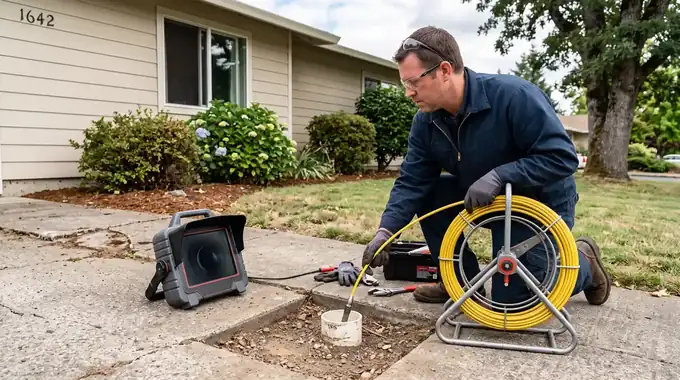
Our high-resolution sewer camera head contains an integrated 512 Hz sonde transmitter. When the camera reaches a root intrusion, offset joint, belly, or break, we walk the yard or floor above with a digital sonde receiver to mark the exact surface spot and measure the burial depth to the inch.
Why does running a drain snake or hydro-jetter without a camera inspection often fail?
Cable augers punch a temporary hole through tree roots or soft blockages without showing why the line backed up. If your sewer lateral is blistered Orangeburg pipe or has a collapsed clay hub, blindly running an aggressive cutter blade can shred the deteriorated pipe wall and get stuck underground.
What is a sewer line "belly" and why is it common in the Rogue Valley?
A sewer belly is a sagged low spot in the underground drain line where seasonal shrinking and swelling of Medford's expansive adobe clay soil has caused the pipe trench to settle. Because water and paper solids pool continuously in the sag instead of flowing down a steady 1/4-inch-per-foot grade, grease and waste accumulate until the line clogs repeatedly.
Can a sewer camera inspection tell if odors inside my home are coming from a cracked drain or a dry trap?
A sewer camera inspects the interior walls of 2-inch to 6-inch waste lines for standing water, root intrusion, and structural cracks. If sewer gas odors persist upstairs or inside wall cavities, we pair camera inspection with low-pressure plumbing smoke testing to reveal hidden vent stack cracks, failed wax rings, or bypassed drum traps.
How long does a sewer scope take in Medford and does it show if trenchless pipe lining will work?
How long does a sewer scope take? A standard residential sewer camera inspection in Medford takes 45 to 75 minutes, including 512 Hz surface depth marking, and clearly shows whether your line is a candidate for trenchless pipe lining Medford (pipelining Medford OR), pipe bursting Medford, or a spot repair.